The Favor Factory
A Gulf royal buys half of the Trump family's crypto company, World Liberty Financial. Nobody says so for a year while money goes in and government acts come out.
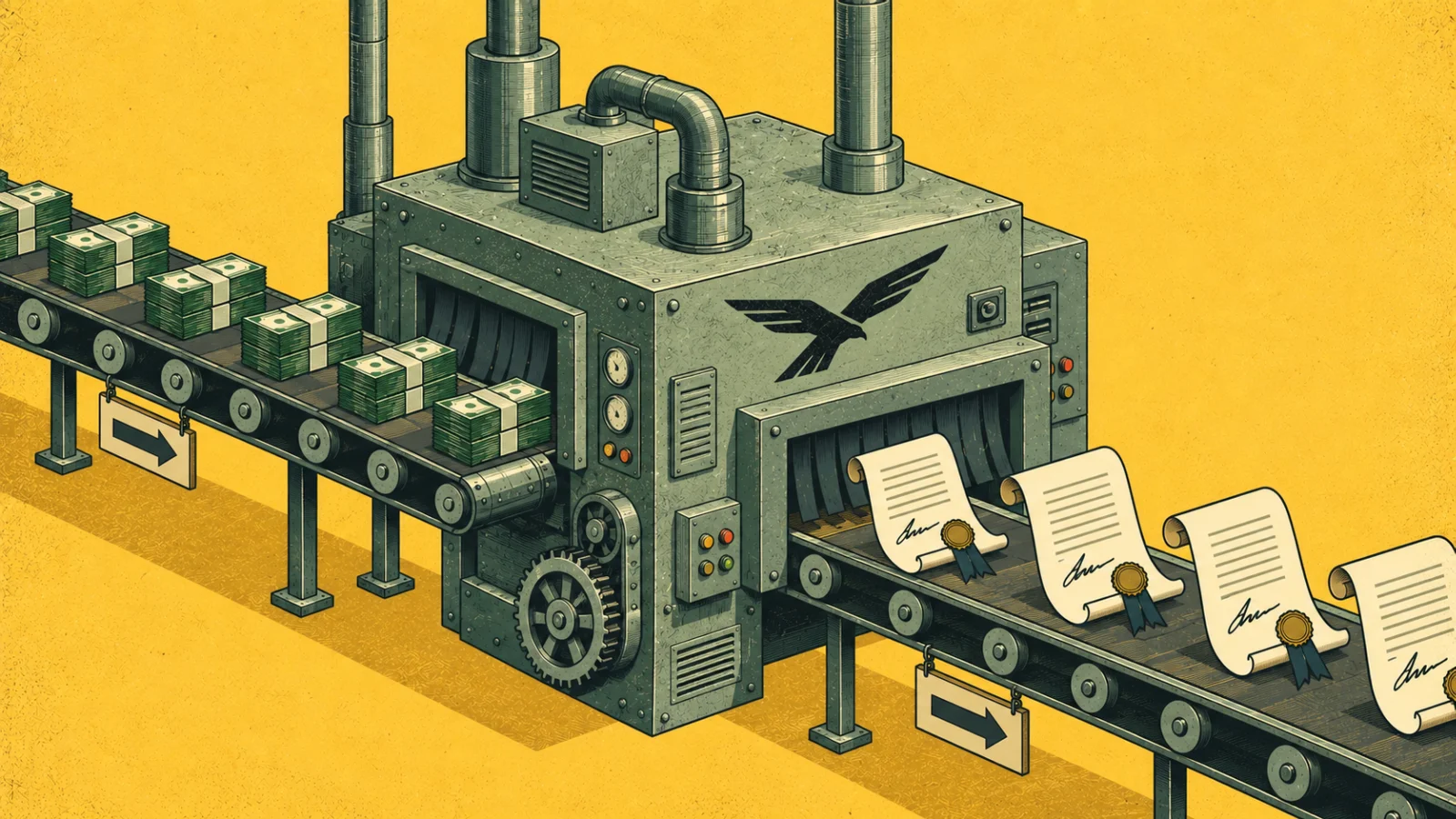
Four days before the inauguration, on January 16, 2025, Sheikh Tahnoon bin Zayed, the United Arab Emirates' national security adviser and the brother of its president, bought 49% of a four-month-old company co-founded by the Trump family and their friends. The price was $500 million. None of this was ever disclosed.
The Wall Street Journal found it in company documents in February 2026, a year after the signature, and called it "something unprecedented in American politics: a foreign government official taking a major ownership stake in an incoming U.S. president's company."
That was just the beginning. The rest of the story is what the United States government did over the following nineteen months for the company Tahnoon had bought into, and for the other people who bought in alongside him. The company, by the way, is in the business of exchanging dollars for digital coins and back into dollars. What could go wrong?
Breaking ground
World Liberty Financial launched on September 16, 2024, seven weeks before the election, in a livestream on X hosted by Trump and his sons. Its founders were Zach Witkoff, son of the man who would become Trump's Middle East envoy, and two crypto entrepreneurs, Zak Folkman and Chase Herro. Eric Trump, Donald Trump Jr. and Barron Trump were listed as co-founders. The company says on its website that 38% of it belongs to "an entity affiliated with Donald J. Trump and certain of his family members."
Its main product is USD1, a stablecoin. A short digression for context: unlike bitcoin and other cryptocurrencies, a stablecoin is pegged to the dollar. Let's say you want to send $1 million to someone in Dubai within an hour. If you can find a bank that will do it, it will take days. So you give World Liberty Financial real dollars. They send a million USD1 to whatever crypto wallet you specified. It stays in USD1 until the recipient wants to exchange it for real dollars, if they ever do. So you got speed and you got to avoid the banking system.
In the interim, your dollars are held in short-term Treasury bills earning interest, and the interest belongs to the issuer, World Liberty, not to you or to anyone holding the coin. USD1 had more than $4 billion in circulation by the summer of 2026. At current rates that is a business worth well over $100 million a year, paid by the U.S. Treasury to a company the president's family owns, for holding other people's money.
The other investor
Tahnoon was not alone. Justin Sun, the founder of the Tron blockchain, had put $30 million into World Liberty in late 2024 and would raise that to about $75 million. Sun had a problem the sheikh did not: the Securities and Exchange Commission had sued him in 2023, alleging wash trading and paying celebrities for undisclosed endorsements.
Five weeks into the new term, on February 26, 2025, the SEC and Sun jointly asked a judge to pause the case, citing a potential resolution. Sun became an adviser to World Liberty while the case sat.
So by the end of February 2025 the factory had its two largest outside shareholders. One wanted American AI chips his country was barred from buying. The other wanted a federal fraud suit to go away. Both had just invested in the president's family.
What it has produced, so far
Within months of the stake, this administration agreed to sell the UAE roughly 500,000 advanced AI chips a year. About a fifth were earmarked for G42, a company Tahnoon chairs. Export rules had kept those chips out of the Gulf over fears they would be passed on to China.
On July 18, 2025, Trump signed the GENIUS Act, the first federal law governing stablecoins. It sets the reserve rules issuers will have to follow and lets compliant coins plug into the regulated banking system. Every stablecoin issuer got the same rules.
In October 2025 he pardoned Changpeng Zhao, the founder of Binance, who had pleaded guilty in 2023 to failing to run an anti-money-laundering program; Binance paid more than $4.3 billion and Zhao served four months. Binance had helped write the code for USD1. In May 2025 an Abu Dhabi fund, MGX, had used USD1 to settle a $2 billion investment in Binance, the largest transaction the coin had ever carried. Reporting places the pardon about a week after Donald Trump Jr. introduced Zhao's lobbyist to the president at a public event.
On March 5, 2026, the SEC dismissed its case against Justin Sun with prejudice in exchange for a $10 million civil penalty. The original complaint had sought far more. The commission's filing gives its reasons, and none of them mention World Liberty.
Six weeks later, Sun sued World Liberty. The company had frozen his tokens in September 2025, a position then worth more than $100 million, using a blacklist function written into the coin's own contract. His complaint, filed April 21, 2026 in federal court in California, says World Liberty froze his $75 million stake, stripped his voting rights, and threatened to burn his tokens and report him to U.S. authorities unless he kept investing. The relief came from the government. The squeeze came from the family.
And on August 14, 2026, the Office of the Comptroller of the Currency, a bank regulator inside the Treasury Department, granted World Liberty preliminary approval to become a national trust bank. The charter lets it issue, redeem and hold USD1 under federal supervision. The OCC charters trust banks routinely, and this one still has conditions to meet. What is not routine is the owner. Senator Elizabeth Warren put it in one sentence:
"President Trump is now the first President in history to approve, operate, and supervise his own bank."
Apparently it's not a bribe if people are just buying shares in your family's firm and then, over months, from agencies that do not coordinate with one another, decisions arrive that happen to help the company and the people who invested. No bag of cash handed over in a DC park. Just a shareholder register on one side, a run of government actions on the other, and one family in the middle. Each act has an official explanation, and none of them is absurd. The chip deal was trade policy. The pardon was clemency. The SEC settles cases. Banks are chartered. One of them, you could call a coincidence. Five of them are not.
The cost you pay
When favors are for sale and people or companies have to pay tribute to stay in the good graces of authority… When you're playing by the rules but someone with more money and power has the refs in their pocket… The same thing happens in every kleptocracy; money flows up, and corruption grows down. Before long you have to grease the palms of local officials just to break ground on your new factory. A real one, the kind the president promised he would bring back.
The factory in five
- Four days before the inauguration, a UAE royal's vehicle buys 49% of the Trump family's crypto firm. Never disclosed.
- Binance, which wrote the code for the firm's coin, sees its founder pardoned.
- Justin Sun, the firm's other big investor, sees his SEC fraud case dropped in exchange for a $10 million civil penalty.
- Commerce authorizes the restricted AI chips the royal wanted, for the company he chairs.
- The president's bank regulator makes the family business into a bank.
Sources: The Wall Street Journal; NPR; Bloomberg; TechCrunch; CNBC; Reuters; Unchained; the Office of the Comptroller of the Currency; the Commerce Department; the Justice Department clemency list; Sen. Warren's office.
Receipts
- A UAE royal takes a 49% stake in the family crypto firm ($500M)
- SEC pauses fraud case against Trump-linked investor Justin Sun
- A $2B Abu Dhabi deal is settled in the family's stablecoin
- Trump signs GENIUS Act stablecoin law
- Trump pardons Binance founder Changpeng Zhao
- Commerce authorizes up to 35,000 Nvidia Blackwell chips for G42, the Abu Dhabi AI firm chaired by the sheikh who bought 49% of World Liberty
- SEC drops fraud case against WLF investor Justin Sun for $10M penalty
- Justin Sun sues World Liberty Financial, saying it froze his $75 million stake and threatened to burn his tokens unless he kept investing
- A Trump-appointed regulator grants the family crypto firm a conditional national bank charter