How a Crisis Becomes the Key
Recep Tayyip Erdoğan survived a real coup attempt in 2016—and turned it into the pretext for the self-coup that followed. Turkey shows how an emergency, even a genuine one, unlocks powers that never get put away.
In July 2016, a faction of the Turkish military tried to overthrow Recep Tayyip Erdoğan and failed. Within hours he called the attempt "a gift from God." He declared a state of emergency, purged the state of some 150,000 people, and rewrote the constitution to concentrate power in himself—all framed as the response to a crisis that was, this time, real.
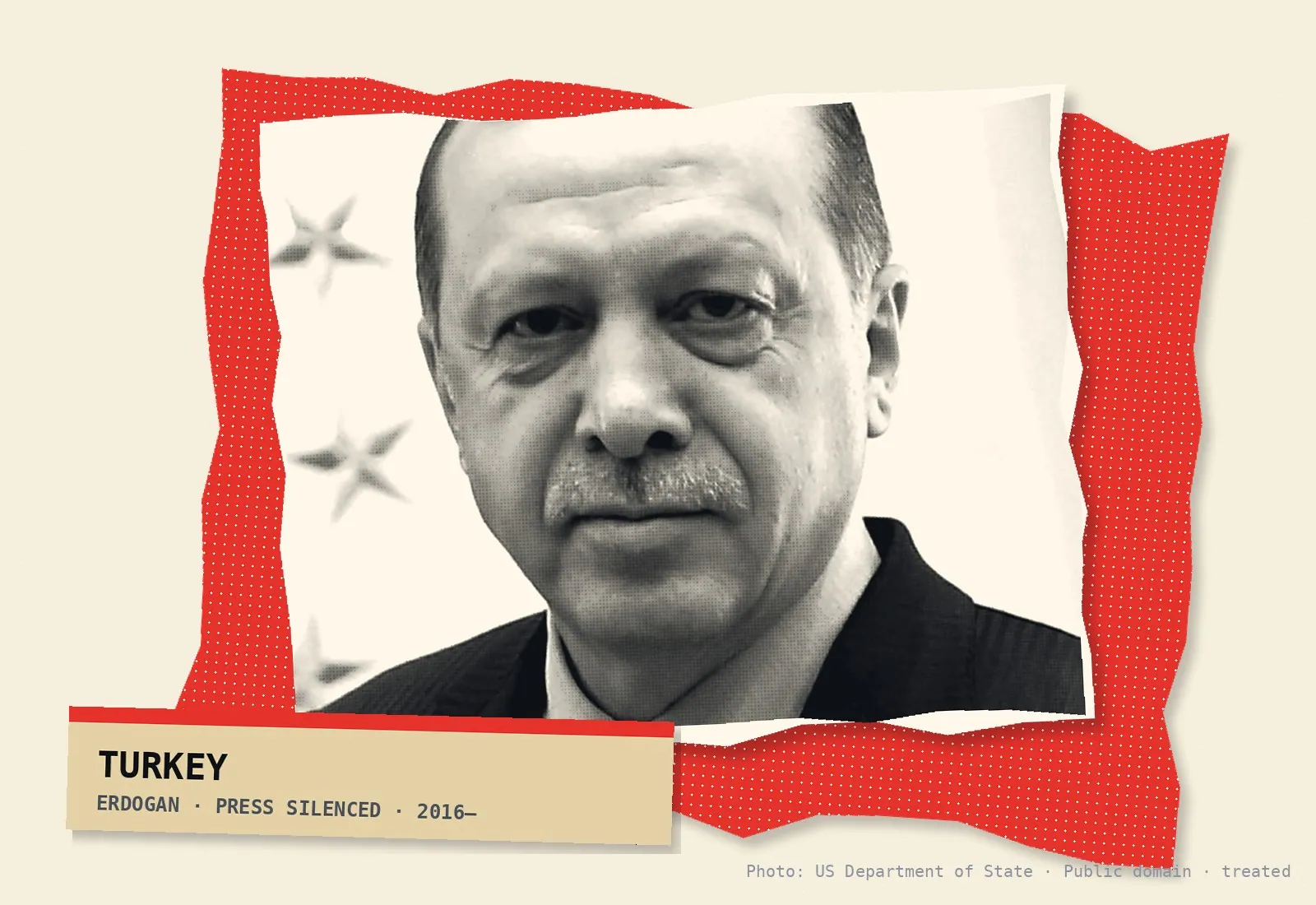
What Erdoğan did
- Turned a real coup attempt into a pretext. Declared a state of emergency after the failed July 2016 putsch and governed by decree.
- Purged the state. Dismissed or jailed roughly 150,000 officials, judges, teachers, soldiers, and police—far beyond anyone plausibly involved in the plot.
- Jailed the press. Turkey became one of the world's leading jailers of journalists and shut scores of outlets.
- Rewrote the office. A narrow 2017 referendum abolished the prime minister and created an executive presidency, concentrating power in Erdoğan himself.
- Went after the opposition. Prosecuted and jailed rivals, from Kurdish leader Selahattin Demirtaş to, later, the mayor of Istanbul.
- Kept the elections. Turkey still holds competitive-looking elections—on a tilted field, with the press and courts already captured.
The same moves, here
Turkey is the pretext playbook: the emergency does the work that force alone cannot. What Ankara teaches is that the key gets cut before the lock—the crisis only turns it.
The putsch was real—tanks on the Bosphorus bridge, bombs falling on parliament. By morning Erdoğan was calling it "a gift from God"; five days later he had the state of emergency that let him rule by decree, renewed again and again until it had outlived any plausible threat.
No unlocking crisis has arrived here yet; the paperwork for one is being drafted. NSPM-7 aims counter-terror authorities at "domestic extremism," National Guard troops have already been federalized onto American streets, and the classified emergency directives—the PEADs—sit ready alongside the Insurrection Act. The powers are pre-positioned. What's missing is the morning that justifies them.
Within a day of the putsch collapsing, nearly 3,000 soldiers were under arrest and more than 2,700 judges suspended; within three weeks, dismissals had passed 40,000, and the EU's enlargement commissioner was observing that at least some of the lists appeared to have been prepared before the coup attempt ever happened. Before the emergency was over, the UN was counting 152,000 civil servants dismissed—teachers, judges, lawyers among them—and nearly 160,000 arrested. The emergency was real; the response was pre-loaded.
The list-making here no longer needs clerks. Fusion platforms can rank millions of people by any criterion the executive names; Schedule F is converting the civil servants who might refuse into employees fireable at will; the prosecutors who investigated the president and the military lawyers who could call a domestic deployment illegal are already gone. Erdoğan built his roster by hand, in a hurry, after the fact. Ours compiles itself, in advance. (How.)
Turkey became the world's leading jailer of journalists. Scores of outlets were shuttered by decree; the ones that survived learned what not to print.
The American instrument is money, not handcuffs—settlements extracted with mergers pending, license reviews floated after critical coverage, public media defunded, universities squeezed through their grants. The destination is the same: newsrooms that quietly learn what a fight costs, and stop picking them.
A referendum—won with 51.4 percent, on what international observers called an unlevel playing field, under emergency rule—abolished the prime minister's office and rebuilt the state as an executive presidency with Erdoğan at its center.
No referendum is needed here. The office grows by memo and court filing: independent agencies folded under White House control, the claim that no agency head is beyond the president's removal power, court orders slow-walked when they lose. The structure changes without a single amendment—which makes it harder to see and harder to vote against.
Turkey still holds elections that look competitive, and the opposition sometimes wins them—which is why the mayor of Istanbul sits in prison. The contest is permitted; winning is punished.
The American ballot still carries real risk for the incumbent—and that is precisely where the pressure is aimed: election officials threatened with prison over voter rolls, maps redrawn mid-decade, doubt seeded so that whatever November produces arrives pre-contested.
How it's going
Erdoğan is now past twenty years in power. He renewed the state of emergency seven times, and when he finally let it expire, in July 2018, parliament wrote its core powers into ordinary law six days later—the decrees stayed, the purged overwhelmingly stayed purged, the presidency stayed rebuilt. The pretext never had to be fake to be exploited. What mattered was that nothing the crisis unlocked was ever handed back.
That is the tell Turkey teaches: watch what a leader keeps after the crisis passes. The tracker follows it in Phase 2 · Construct a pretext.
One of nine case studies. Other countries have been through this. If you want the long view first, read The Oldest Way to Kill a Republic.
See where these moves sit on the map.
Every parallel above is a live case file in the tracker, with its own receipts.
Open Tracker →