The Endpoint of the Slow Method
Vladimir Putin came to power by election and has never lost one since. Russia shows where the slow, legal self-coup arrives if nothing stops it: a country that still holds votes, and where the vote no longer matters.
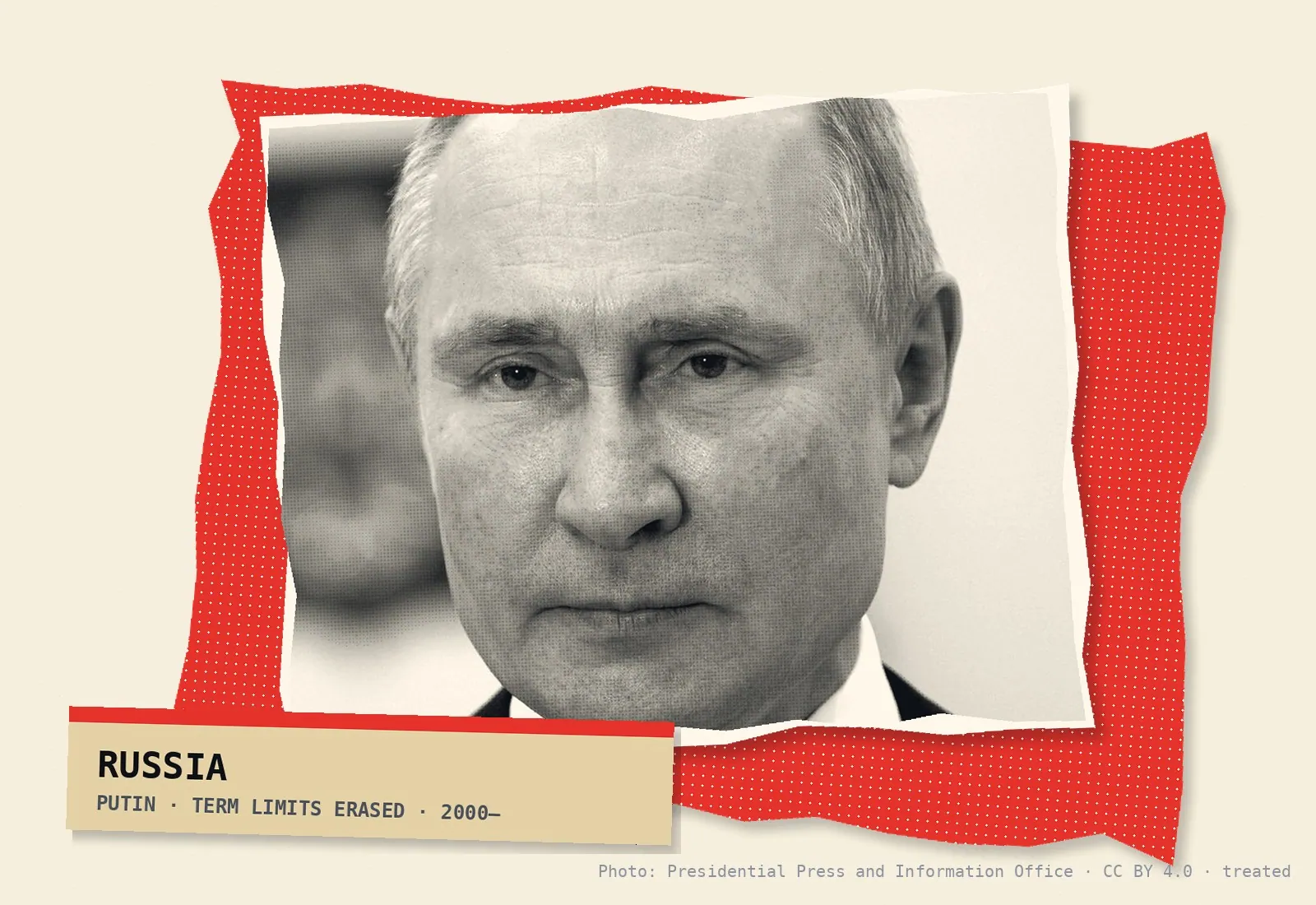
Vladimir Putin was elected in 2000. A quarter-century later he still holds power, having reset the term limits that were supposed to end his rule—all while keeping the ballots, the parliament, and the courts formally in place. Russia is the autocoup at its terminus: the forms of a republic, fully hollow.
What Putin did
- Seized the screens first. In his early years he brought national television under state control, taking over the independent network NTV in 2001.
- Ended elected governors. After the 2004 Beslan school siege, he used the crisis to abolish the direct election of regional governors and appoint them himself.
- Turned the security services inward. Built his rule on the FSB and used prosecutions to destroy rivals—from the oligarch Mikhail Khodorkovsky to opposition leader Alexei Navalny.
- Dodged the term limit, then erased it. Swapped into the prime minister's seat in 2008 to stay within the letter of the constitution, returned in 2012, then in 2020 amended the constitution to reset his term count—clearing the way to rule until 2036.
- Strangled the press and civil society. "Foreign agent" laws choked independent media and NGOs into silence or exile.
- Kept the elections. Russia still votes. The result has not been in doubt for years.
The same moves, here
Russia is the case that answers "and then what?" Nothing below claims America is there. It claims something more useful: each of Putin's moves has a younger, milder cousin already on the tracker—and Russia shows what the grown version looks like.
Within a year of taking office, Putin took NTV—the network whose satire show mocked him—in a boardroom raid dressed up as a debt dispute. National television never seriously criticized him again. He didn't censor the press; he owned it.
No raids here; leverage does the work. Paramount settled a lawsuit it would once have fought while a merger sat before the government. The FCC floats license reviews after unfriendly coverage. Public broadcasting lost its federal funding. The screens are not being seized—they are being taught caution, one business decision at a time.
Putin came from the FSB and governed through it. Investigations became the instrument of politics: whoever crossed the Kremlin discovered a tax problem, a fraud case, a search of their offices.
The younger cousin is already visible: a presidential directive aiming counter-terror tools at "domestic extremism," a brand-new threat category invented for citizens who objected to data centers at town halls, and a fused federal database that can find anyone the executive names. The machinery that watches immigrants today is authorized, not just able, to watch anyone tomorrow.
Khodorkovsky's arrest taught every oligarch the price of funding the opposition. Navalny's poisoning and prison death taught everyone else. Most Russians never needed to be touched at all—they watched, understood, and adjusted on their own.
This is the mechanism to watch here, because it works without a single arrest. Once Americans understand that donations, rally attendance, and posts are logged where the government can reach them, most will quiet themselves for free. Deterrence is the cheapest instrument in the autocrat's kit—and the surveillance stack is what makes it credible.
Putin honored the letter of the constitution by swapping into the prime minister's seat in 2008, returned in 2012, then in 2020 amended the constitution to reset his term count to zero—clearing his path to 2036. Legality theater, the whole way.
Nothing that far has happened here—and that is exactly why this case matters. What exists is the stated ambition, on the record at Mount Rushmore ("we will not lose an election for a hundred years"), and the machinery accumulating around the vote. Russia is what the road looks like if every mile keeps reading as legal.
Russia still votes, on schedule. The elections are ritual, not risk—they exist to display consent, not to test it.
The American ballot still carries genuine risk for the man in power. The distance between our elections and theirs is the entire distance this tracker measures—and every documented move on it shortens that distance a little.
How it's going
Twenty-five years and counting; the 2020 amendments run to 2036. Russia is the destination, not a detour—a managed autocracy that never stopped holding elections, which is exactly what makes it so hard to name from the inside. Nobody woke up in Moscow on the morning democracy ended, because there was no such morning. Russians kept voting the whole way down.
The lesson is about timing. The slow method is stoppable early, while the referees and the press are still independent—the window the tracker calls Phase 1 · Tear out the safeguards. Once they are gone, the ballot alone will not bring them back.
One of nine case studies. Other countries have been through this. If you want the long view first, read The Oldest Way to Kill a Republic.
See where these moves sit on the map.
Every parallel above is a live case file in the tracker, with its own receipts.
Open Tracker →